

Client
Date
Location
Budget
Needs
DP Energy was developing a tidal farm off Fair Head, an energetic tidal site on the north coast of Northern Ireland, where earlier work relied on a vessel-mounted ADCP survey and a hydrodynamic model. To characterise the site for design, ARR (Applied Renewables Research) ran a seabed ADCP campaign at three locations and needed the data quality-controlled and analysed for currents and turbulence.
Objectives
Obtain quality-controlled current data at three candidate locations
Describe the tidal current: strength, asymmetry, directions, shear and statistics
Characterise turbulence for the modelling of turbine loads
Missions
Resources deployed
Three Teledyne RDI Workhorse Sentinel 600 kHz ADCPs with waves firmware, in gimballed seabed frames
Single-ping recording in beam coordinates every 0.5 to 1 s, 1 to 1.5 m cells, in about 42 m of water
DynamOcean in-house Matlab toolbox for quality control and turbulence analysis
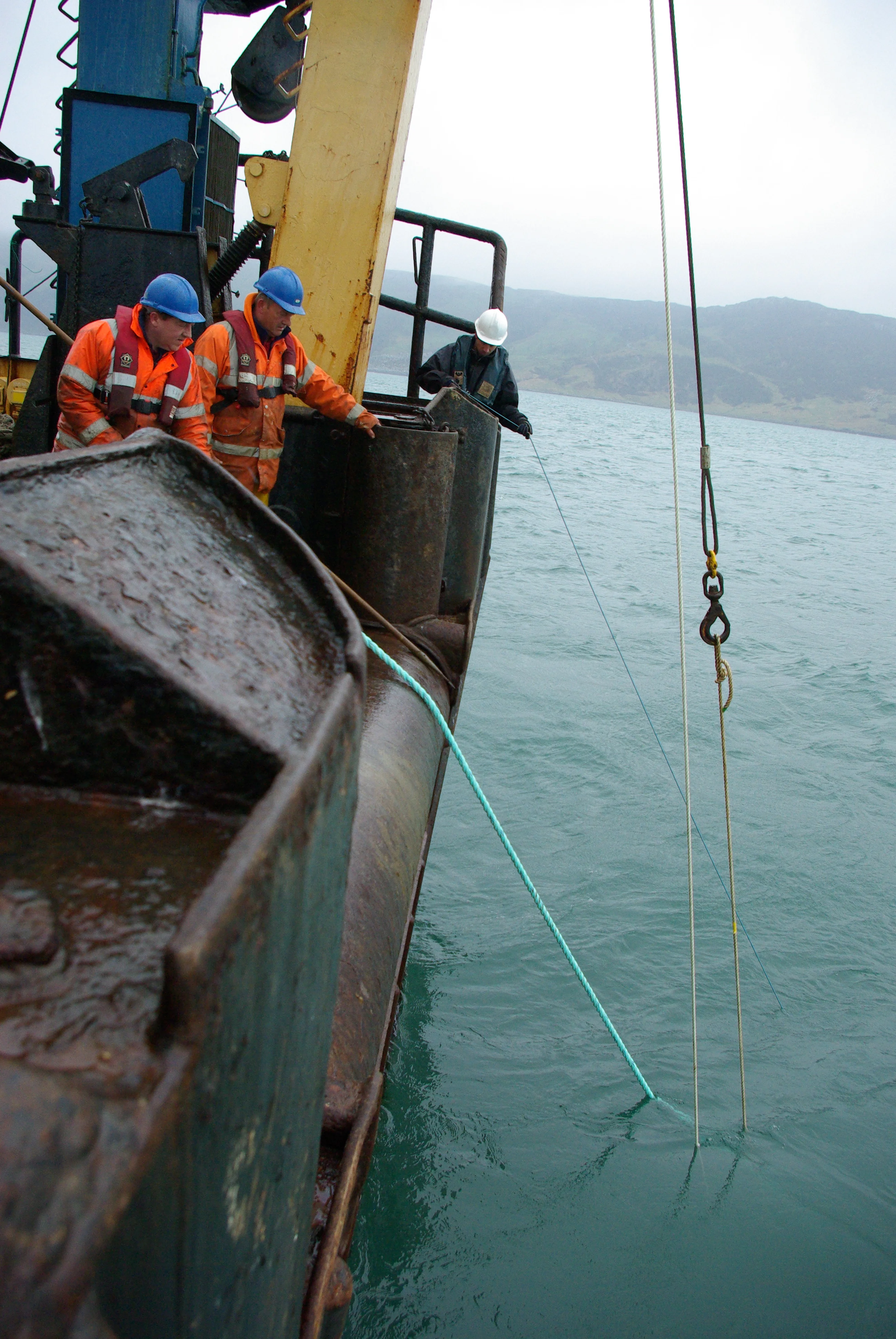
Lowering the ADCP frame to the seabed at Fair Head
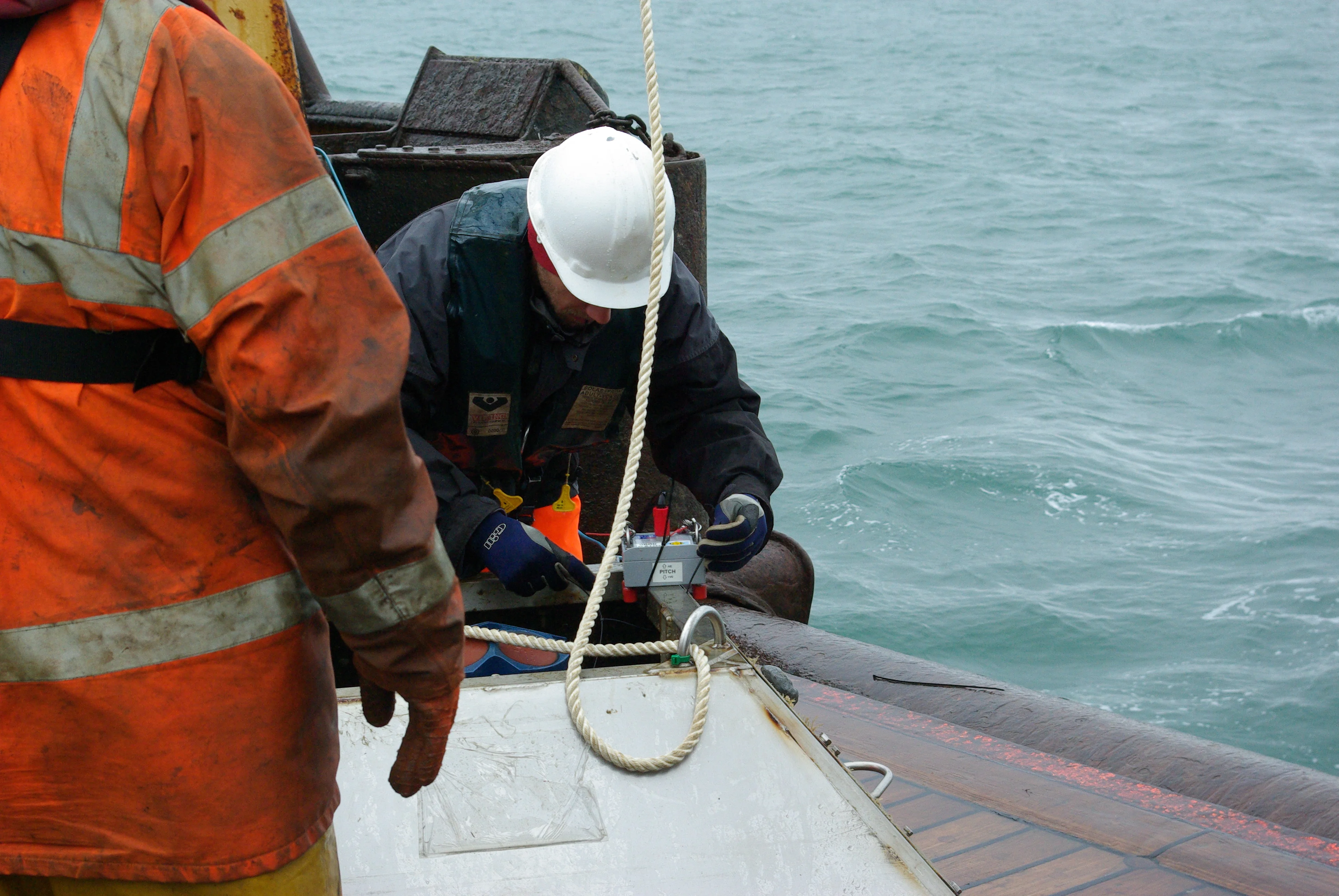
Checking the ADCP and tilt sensor in the frame before deployment
Results
3
seabed ADCP sites
43
days of measurements
3.8 m/s
maximum flood current (10-min average)
2.7 m/s
maximum ebb current (10-min average)
- Good overall data quality at all three sites
- Similar current patterns at the three sites: bidirectional flow, with a flood stronger than the ebb
- Best directions for a fixed-azimuth turbine determined for each site, between 105° and 120°
- Shear and turbulence intensity statistics supplied as inputs for turbine modelling
- Recommendation to run a harmonic analysis for long-term statistics and reference levels
Our added value
When one beam occasionally gave poor data, DynamOcean reprocessed the records with 3-beam solutions to recover usable data. The report also drew on DynamOcean's own research showing that 4-beam ADCPs overestimate turbulence normal stresses, so the client knew how to use these values.