

Client
Date
Location
Budget
Needs
SIMEC Atlantis is preparing MeyGen phase 2 in the Inner Sound of the Pentland Firth, where currents reach 5 m/s and more than 10 new tidal turbines are planned. Energy yield and design require accurate flow data at each future turbine location, whereas the industry mainly relies on hydrodynamic models. The developer also needed to understand the wakes of the phase 1 turbines already in operation.
Objectives
Estimate long-term current speeds and energy potential at each future turbine location
Characterise the wakes of the operating MeyGen 1 turbines
Characterise currents, waves and turbulence at a reference seabed ADCP
Missions
Resources deployed
Teledyne RDI Sentinel V 500 kHz seabed-mounted ADCP, 35 days of measurements
Teledyne RDI Workhorse 600 kHz vessel-mounted ADCP for semi-stationary stopovers and transects
DynamOcean Matlab tools, including an improved moving-boat velocity solver and UTide harmonic analysis
Survey vessel operated with Applied Renewable Research
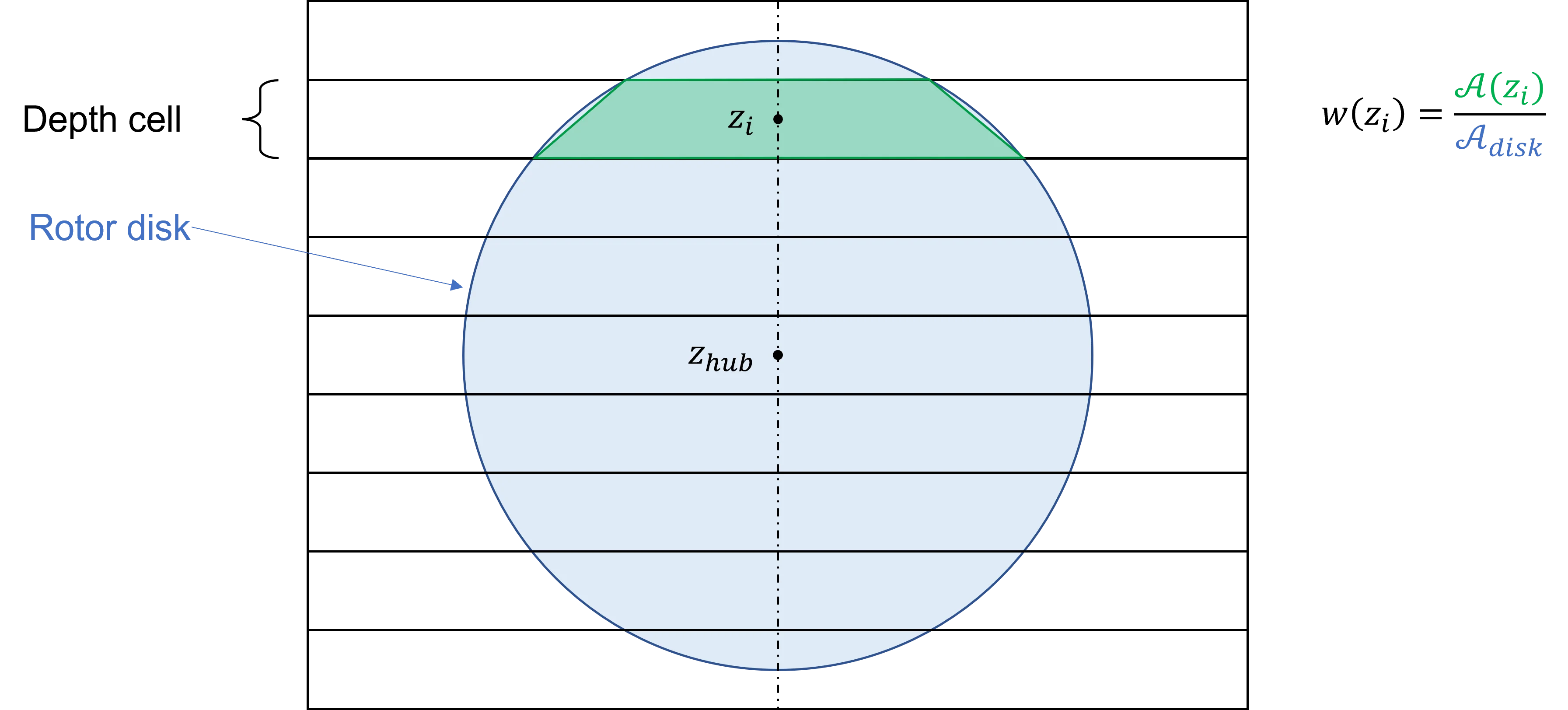
Depth cell weighting for the rotor disk averaged velocity (IEC method of bins)
Results
35 days
extended to 18.6 years by prediction
17
locations with long-term predictions
13 h
vessel-mounted stopover per location
5 m/s
peak currents on site
- 18.6-year predictions of rotor-disk averaged velocities at 17 locations, separated between flood and ebb
- A quick and consistent Measure-Correlate-Predict method for the energy potential of a future tidal array
- Turbine wakes mapped on flood and ebb, with turbines running and stopped
- Work reported in a TIGER project deliverable and in two papers at the EWTEC 2023 conference
Our added value
DynamOcean applied an improved velocity solver for vessel-mounted ADCP data to tidal turbine wakes for the first time. Combining short vessel stopovers with one long seabed record gave flow estimates at every future turbine position without a seabed ADCP at each one.