

Client
Date
Location
Budget
Needs
Flumill needed flow and wave measurements at its berth on EMEC's Shapinsay Sound nursery tidal test site to test its turbine and assess its performance. The measurements had to follow EMEC's guidelines for tidal resource and performance assessment, be available in real time during the sea trials and, ideally, capture turbulence, which strongly affects turbine performance and loads.
Objectives
Measure the incoming flow at a location representative of the turbine but undisturbed by it
Provide current speed and direction to shore in real time during the trials
Characterise turbulence as well as mean flow and waves, in line with EMEC guidelines
Missions
Resources deployed
Teledyne RDI Workhorse Sentinel ADCPs, with a twin synchronised set-up specified for 5-beam turbulence measurement
Heavy-duty seabed frame levelled within ±6°, checked at deployment with a tilt tracker
Surface buoy with battery and radio modems relaying single-ping data at 2 Hz to a shore PC
In-house Matlab tools: RDI quality-control guidelines, phase-space despiking and bin mapping
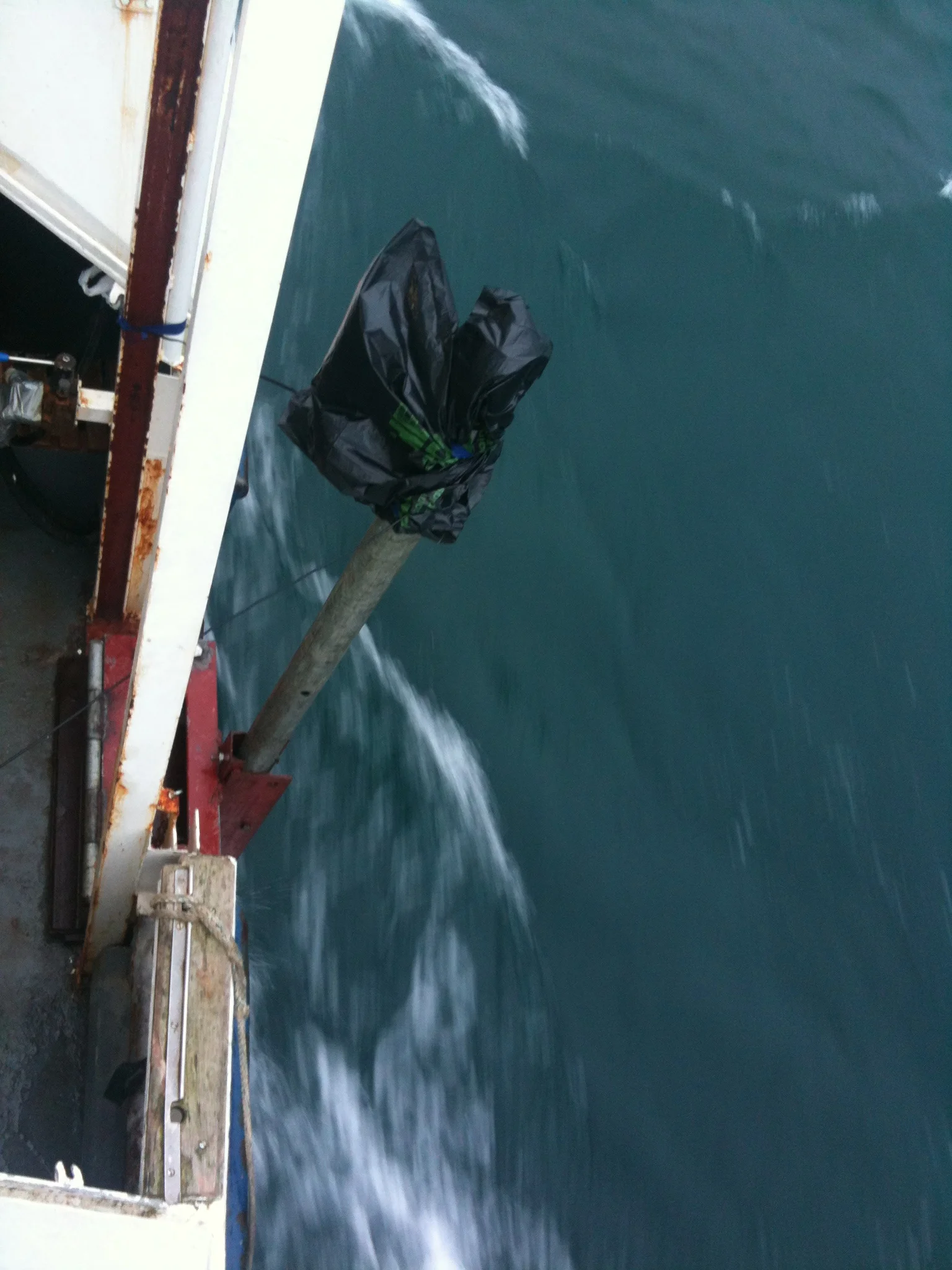
Instrument mounting pole deployed over the side of the vessel
Dusk over the tidal channel during the monitoring operations
Results
- Monitoring set-up defined in line with EMEC's resource and performance assessment guidelines
- ADCP position set about 2.5 device widths upstream so the measured flow is not disturbed by the turbine
- Real-time current information available to the test team throughout the sea trials
- Quality-controlled current and turbulence data delivered for the turbine performance assessment
Our added value
Turbulence was not required by the reference guidelines. DynamOcean showed that a 4-beam ADCP has to assume the turbulence anisotropy, and specified a synchronised twin-ADCP set-up giving a fifth vertical beam, so that all three turbulence components could be measured.