

Client
Date
Location
Budget
Needs
As part of the EPR2 project at the Gravelines nuclear power plant, EDF needed to know the suspended sediment concentrations (SSC) found in the Dunkirk West outer port, particularly in its south-west area near the existing cooling water intake. The temporal and spatial variability of SSC had to be understood in relation to waves, harbour agitation and currents.
Objectives
Determine the range of SSC in the south-west area of the outer port
Characterise the temporal and spatial variability of SSC near the water intake
Measure the hydrodynamic forcing: offshore swell, harbour agitation and currents
Missions
Resources deployed
Two Nortek Signature 1000 ADCPs on seabed frames for currents, waves and backscatter
NKE WiMo+ turbidity probes 1 m above the seabed and 1 m below the surface, recording every 10 minutes
Profilers combining a WiMo probe with a LISST laser particle-size analyser or a Van Dorn sampling bottle
Teledyne RDI RiverPro ADCP with bottom tracking and Hemisphere GNSS, processed with WinRiver II
Laboratory SSC analysis of water samples and in-house Matlab processing
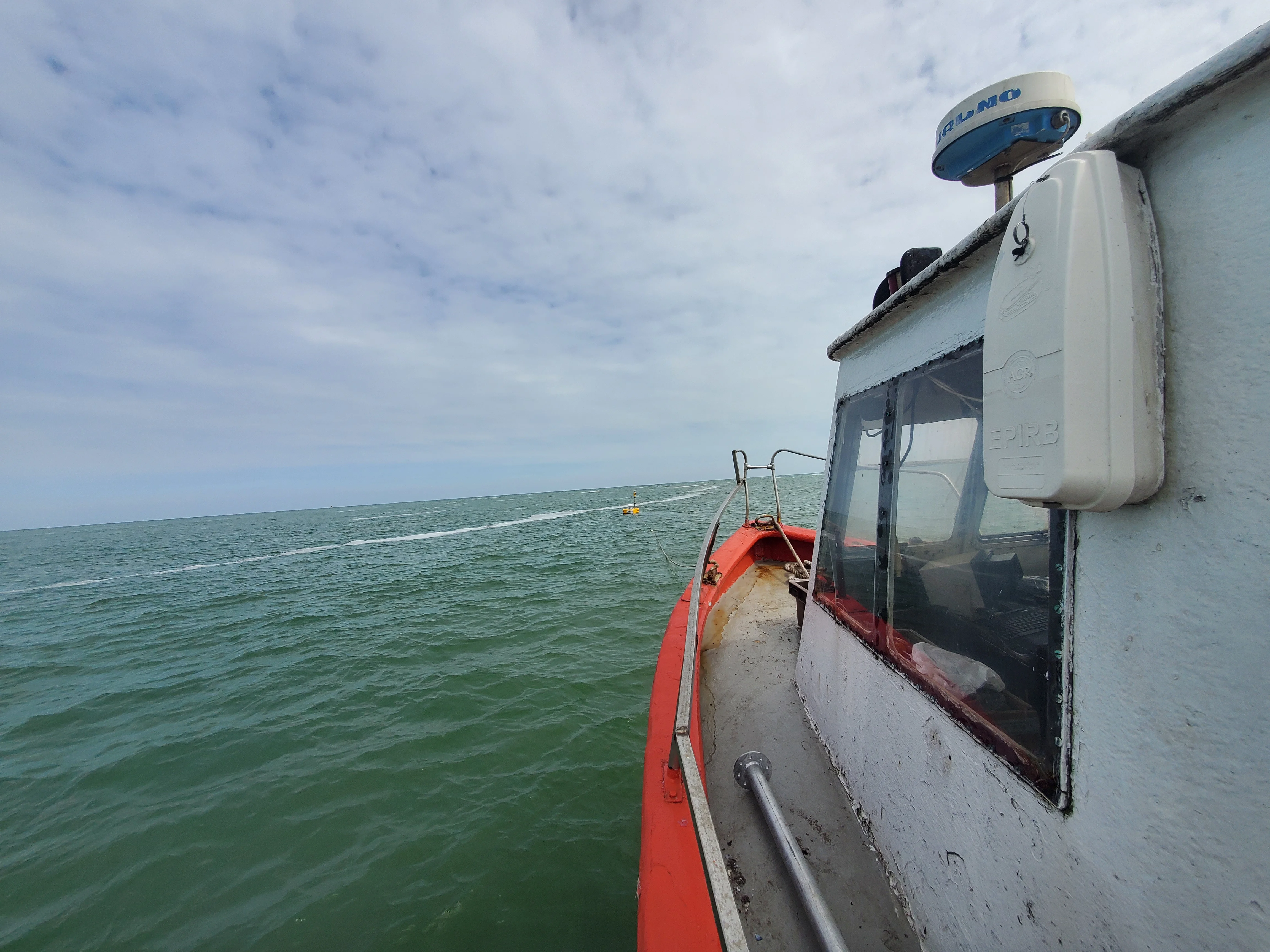
Survey boat approaching a measurement station
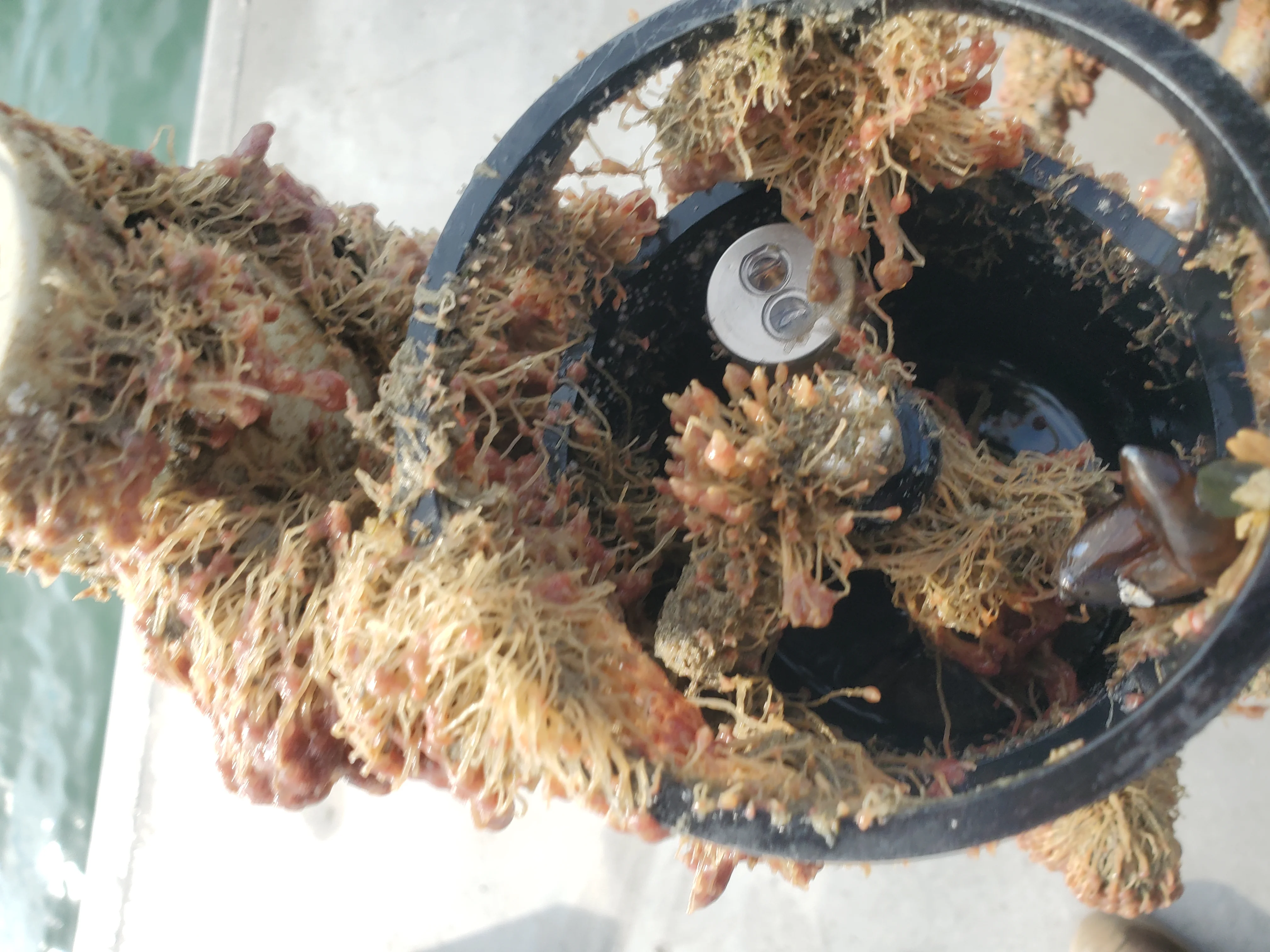
Biofouling on a turbidity probe after several weeks at sea
Results
6
months of fixed-station measurements
7
profile points
1.5 m/s
maximum current near the surface
R² ≥ 0.995
turbidity-to-SSC calibration
- Currents up to 1.5 m/s near the surface at the exposed station, below 0.5 m/s at the sheltered station near the intake
- Significant wave heights above 4 m in winter at the exposed station, mostly below 0.5 m at the sheltered station
- SSC higher in winter than in spring and lower near the intake, with a clear spring-neap tidal signal
- Turbidity-to-SSC laws for each probe, confirmed by water samples, applied to fixed records and profiles
- Time series, profiles and transects delivered in Excel and ASCII formats for EDF studies
Our added value
DynamOcean calibrated each turbidity probe in the laboratory with mud sampled on site (mixture method) and checked the laws against simultaneous water samples. This turned turbidity readings into reliable SSC values, the quantity EDF actually needed.